US stock futures sink, yen gains on China deflationary pressures, trade war

Wall Street futures sank and the safe-haven yen strengthened early on Monday as building deflationary pressures in China added to growth worries from a fading U.S. economy and a simmering global trade war.U.S. S&P 500 e-mini stock futures pointed 0.7% lower and Nasdaq futures sagged 0.9%.The yen gained about 0.4% to 147.395 per U.S. dollar.Cryptocurrency bitcoin lost as much as 7.2% from Friday to reach the lowest this month at $80,085.42.Data on Sunday showed China's consumer price index fell at the sharpest pace in 13 months in February, while producer price deflation extended to a 30th straight month.Friday's U.S. figures showed the labour market created fewer jobs than expected last month in the first monthly payrolls report capturing President Donald Trump's policies. That extended a recent run of soft readings for the world's biggest economy.Meanwhile, Trump in a Fox News interview on Sunday declined to predict whether his tariffs on Canada, Mexico and China would result in a U.S. recession."There's no shortage of possible catalysts" for early weakness in markets, said Kyle Rodda, senior financial markets analyst at Capital.com."Most of all though, I think it's Trump's cavalier approach to economic policy that's rattling sentiment," Rodda said."Unlike during his first administration,…

China announces retaliatory tariffs on some Canada farm, food products

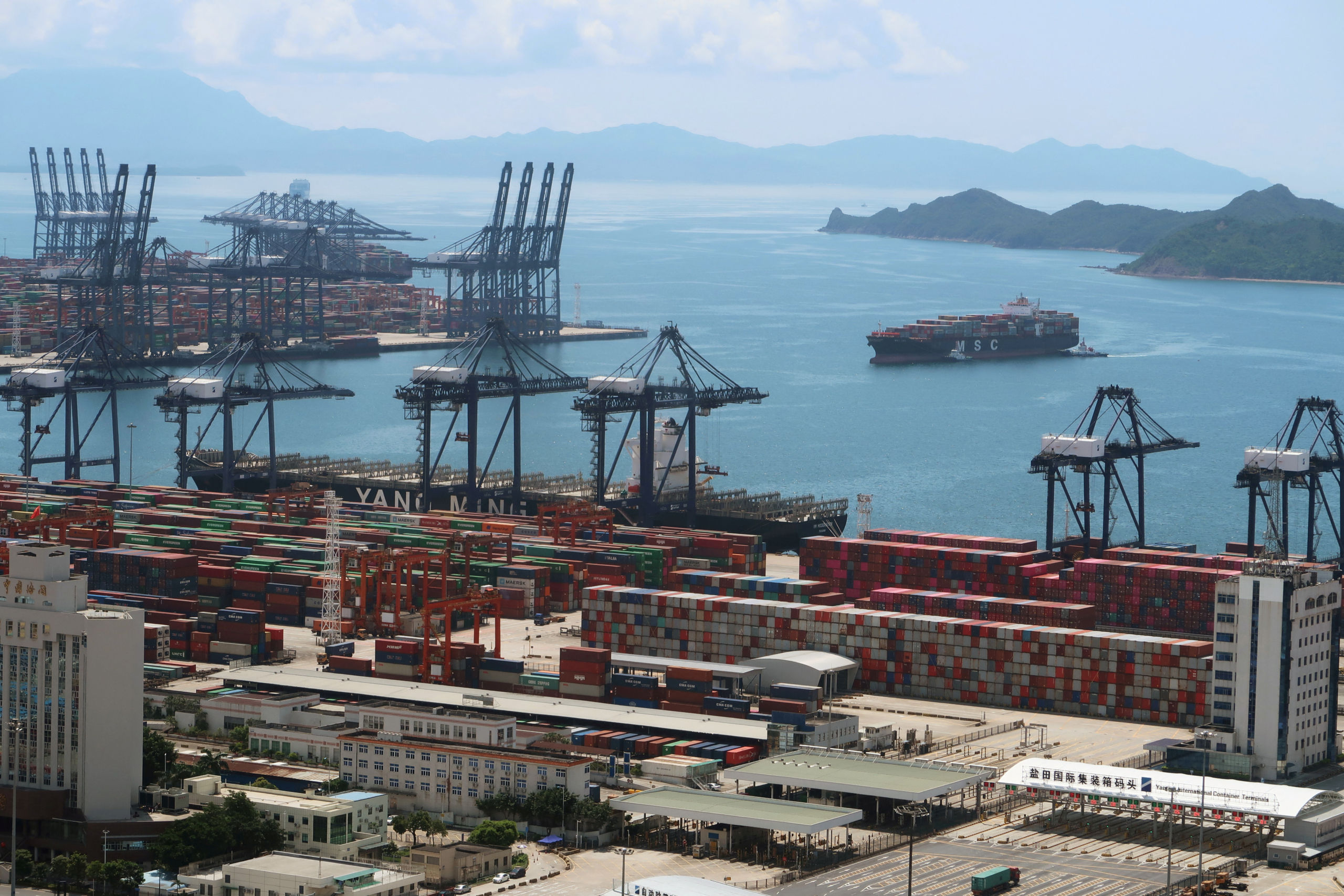
China announced tariffs on Canadian agricultural and food products on Saturday, retaliating against levies Ottawa introduced in October on Chinese-made electric vehicles and steel and aluminium products.The tariffs announced by the commerce ministry, to take effect on March 20, add a new front to a trade war largely driven by U.S. President Donald Trump's announcement of tariffs on Canada, Mexico and China and threats of protectionist measures on other nations.China will apply a 100% tariff to Canadian rapeseed oil, oil cakes and pea imports, and a 25% duty on Canadian aquatic products and pork, the ministry said in a statement.Canada's 100% tariff on Chinese EVs and 25% levy on its aluminium and steel products "seriously violate World Trade Organization rules, constitute a typical act of protectionism and are discriminatory measures that severely harm China's legitimate rights and interests," the ministry said.Canadian Prime Minister Justin Trudeau said in August that Ottawa was imposing the levies to counter what he called China's intentional state-directed policy of over-capacity, following the lead of the United States and European Union, both of which have also applied import levies to Chinese-made EVs.China is Canada's second-largest trading partner, trailing far behind the United States.Source: Reuters.com

Canada launches C$5 billion program to help exporters reach new markets

Canada is launching a C$5 billion program to help Canadian exporters reach new markets as part of measures to support businesses and workers in response to U.S. tariffs, the federal government said in a statement Friday.The government will also make C$1 billion in new financing available through Farm Credit Canada to help farmers and agricultural businesses address cash flow problems, the statement said.U.S. President Donald Trump's administration imposed 25% tariffs on most imports from Canada and Mexico earlier this week, before announcing a suspension of the charges until April 2 on goods covered by the U.S.-Mexico-Canada Agreement on trade."We are moving ahead with these changes despite yesterday's pause because businesses and workers need assurances right now," Labour Minister Steven MacKinnon said at a news conference on Friday."We may not know what our American neighbors will do, nor what new tale they will tell, but we are united."Canada relies on the United States for 75% of its exports and a third of all imports. Its reliance on trade for economic growth leaves the country vulnerable to a protracted trade war.Source: Reuters.com

Canada gains a net 1,100 jobs in February, jobless rate holds at 6.6%

OTTAWA, March 7 (Reuters) - Canada's economy gained a net 1,100 jobs in February, entirely in part-time work, and the jobless rate held at 6.6%, Statistics Canada data showed on Friday.Employment in the goods producing sector fell by a net 19,500 jobs, largely in utilities. The services sector was up by a net 20,600 positions, led by wholesale and retail trade, as well as finance, insurance, real estate, rental and leasing.Feb 2025 Jan 2025Jobs gain/loss +1,100 +76,000full-time -19,700 +35,200part-time +20,800 +40,900Unemployment rate 6.6% 6.6%Participation 65.3% 65.5%Labor force 22.467 mln 22.484 mlnFeb 2025 Feb 2024 % changeAvg hourly wage C$36.94 C$35.53 +4.0NOTE: Analysts surveyed by Reuters had forecast an increase of 20,000 jobs in February, and for the unemployment rate to rise to 6.7%. Hourly wage figures are for permanent employees.(Reporting by Dale Smith; Editing by Promit Mukherjee) (([email protected]))Keywords: CANADA ECONOMY/EMPLOYMENTSource: Reuters.com

Canadian Q4 industry capacity use edges up to 79.8%

OTTAWA, March 7 (Reuters) - Canadian industries ran at 79.8% of capacity in the fourth quarter of 2024, higher than the upwardly revised 79.4% in the third quarter, Statistics Canada said on Friday.The increase was largely attributed to growth in the construction sector, as well as petroleum and coal product manufacturing.Following are the rates in percent:Q4 2024 Q3 2024 (rev) Q3 2024 (prev)Cap. utilization 79.8 79.4 79.3Manufacturing 78.2 78.1 78.2(Reporting by Dale Smith; editing by Promit Mukherjee) (([email protected]))Keywords: CANADA ECONOMY/INDUSTRIAL CAPACITYSource: Reuters.com

Canada’s February unemployment rate unchanged, economy adds few jobs

Canada's unemployment rate held steady at 6.6% in February while new job additions were only marginally up, data showed on Friday, reflecting the early potential impact of uncertainty over U.S. tariffs on corporate hiring decisions.The economy added a net of 1,100 jobs, Statistics Canada said, a sharp contrast to the addition of 76,000 jobs in January and a cumulative increase of 211,000 from November to January.Analysts polled by Reuters had estimated the unemployment rate at 6.7% and net addition of 20,000 jobs in February.This is the final major data to be released before the Bank of Canada's monetary policy decision on March 12. Currency swap markets are showing that there is an around 73% chance that the bank will cut interest rates for the seventh time in a row to 2.75%.The Canadian dollar extended losses after the labor data, trading down 0.3% to 1.4339 versus the U.S. dollar, or 69.74 U.S. cents. Yields on two-year government bonds were down 3.9 basis points at 2.6%.Canada's unemployment rate has been improving from late last year since a peak of 6.9% in November, spurred by falling interest rates as inflation came within the Bank of Canada's 1% to 3% target range and economic…

Canada’s economy adds few jobs in February; unemployment unchanged

Canada's unemployment in February was unchanged from the prior month and new job additions was only marginally up, data showed on Friday, showing early signs of an impact of uncertainty around U.S. tariffs on hiring decisions of companies.The unemployment rate for February was at 6.6% and the economy added a net of 1,100 jobs, Statistics Canada said.Market reaction:Link: https://www150.statcan.gc.ca/n1/daily-quotidien/250307/dq250307a-eng.htm?HPA=1COMMENTARYANDREW KELVIN, HEAD OF CANADIAN AND GLOBAL RATES STRATEGY AT TD SECURITIES"What makes it difficult to really interpret this data is.. the weather in February was rather poor. I'm more focused on the hours worked number, which suggests a degree of disruption due to weather.""I don't think people in Canada were taking the tariff threat as seriously, really until later in January. February is the first month where we will be able to discern these impacts of uncertainty. And this is the first piece of sort of hard data we have for February, so it bears watching.""If we see this trend emerge over March and over April, I think we can start doing, maybe, a bit firmer conclusions."DOUG PORTER, CHIEF ECONOMIST, BMO CAPITAL MARKETS"I think the market will largely look past this one for a couple reasons. First of all, of course,…

Brazil’s economy grows 3.4% in 2024 but year-end weakness signals fewer rate hikes

Brazil's economy grew 3.4% in 2024, the strongest since the post-pandemic rebound, but momentum slowed more than expected in the fourth quarter as restrictive monetary policy weighed on activity, fueling bets of an earlier end to the rate hike cycle.The annual growth of Latin America's largest economy, reported on Friday by statistics agency IBGE, once again defied market expectations for a more modest increase, supported by strong gains in investment and household consumption amid government policies aimed at boosting disposable income.The performance in President Luiz Inacio Lula da Silva's second year in office marked an acceleration from the 3.2% expansion recorded in 2023, and was the best since the 4.8% growth seen in 2021.However, the economy showed signs of cooling in the final three months of the year as it expanded just 0.2% from the third quarter, missing the 0.5% median forecast in a Reuters poll of economists.This followed downwardly revised 0.7% growth in the third quarter over the previous three-month period.Jason Tuvey, deputy chief emerging markets economist at Capital Economics, said the data confirms that Brazil's "recent period of strong growth has come to an abrupt end."He now projects 1.8% economic growth for 2025, down from a previous forecast…

TSX futures flat, but index set for worst week in six months

Futures linked to Canada's primary stock index held steady on Friday, although the benchmark was on track for its biggest weekly fall in nearly six months.The futures on the S&P/TSX index were down 1% at 6:25 a.m. ET (1125 GMT).The S&P/TSX composite index (.GSPTSE) dropped 286.78 points, or 1.2%, on Thursday, settling at 24,584.04. The index was set to drop 3.2% for the week, the biggest loss since September 2024 if losses hold post open.Throughout the week, investors navigated a roller coaster of trade uncertainties. On Tuesday, U.S. President Donald Trump's 25% tariffs on imports from Canada and Mexico took effect. But, in the latest twist on Thursday, Trump announced an exemption for goods from both nations under a North American trade pact, lasting a month.On the economic data front, Canada's labor report for February is scheduled for release at 8:30 a.m. ET on Friday. Concurrently, the U.S. Labor Department's nonfarm payrolls report is anticipated to reveal an addition of 160,000 jobs in February.Market participants will also be monitoring comments from U.S. Federal Reserve Chair Jerome Powell at 12:30 p.m. ET, which may offer clarity on the central bank's policy direction.In the commodities sector, oil prices rose 1.34% on Friday,…

Trump’s ‘shock and awe’ agenda leaves Virginia businesses scrambling

Will Paulette's latest apartment construction project was mired in mud as a rainstorm passed through this week, a situation that matched the murky outlook for builders who are assessing how sweeping new tariffs might affect their costs, the flow of work, and the willingness of developers and lenders to commit to projects.Nothing has been canceled yet, he said from the office at the site of KBS Inc's 162-unit building in Richmond's Manchester area, but investors and banks were becoming wary, and subcontractors were reluctant to guarantee prices for often-imported goods like drywall that he might typically order now but for delivery months down the road - when threatened tariffs as high as 25% might be in place on source countries like Mexico and Canada.The levies were to take effect this week, but Trump delayed them to April, as he did once before, a pattern that has made investment a guessing game and may be driving measures of uncertainty ever higher."We are trying not to overreact organizationally...The next day this could be changed," he said. "We are in the middle of pricing work...and our conversation with owners would be I don’t think you want us to price in the worst-case scenario,…