Oil boosts Abu Dhabi, Dubai falls

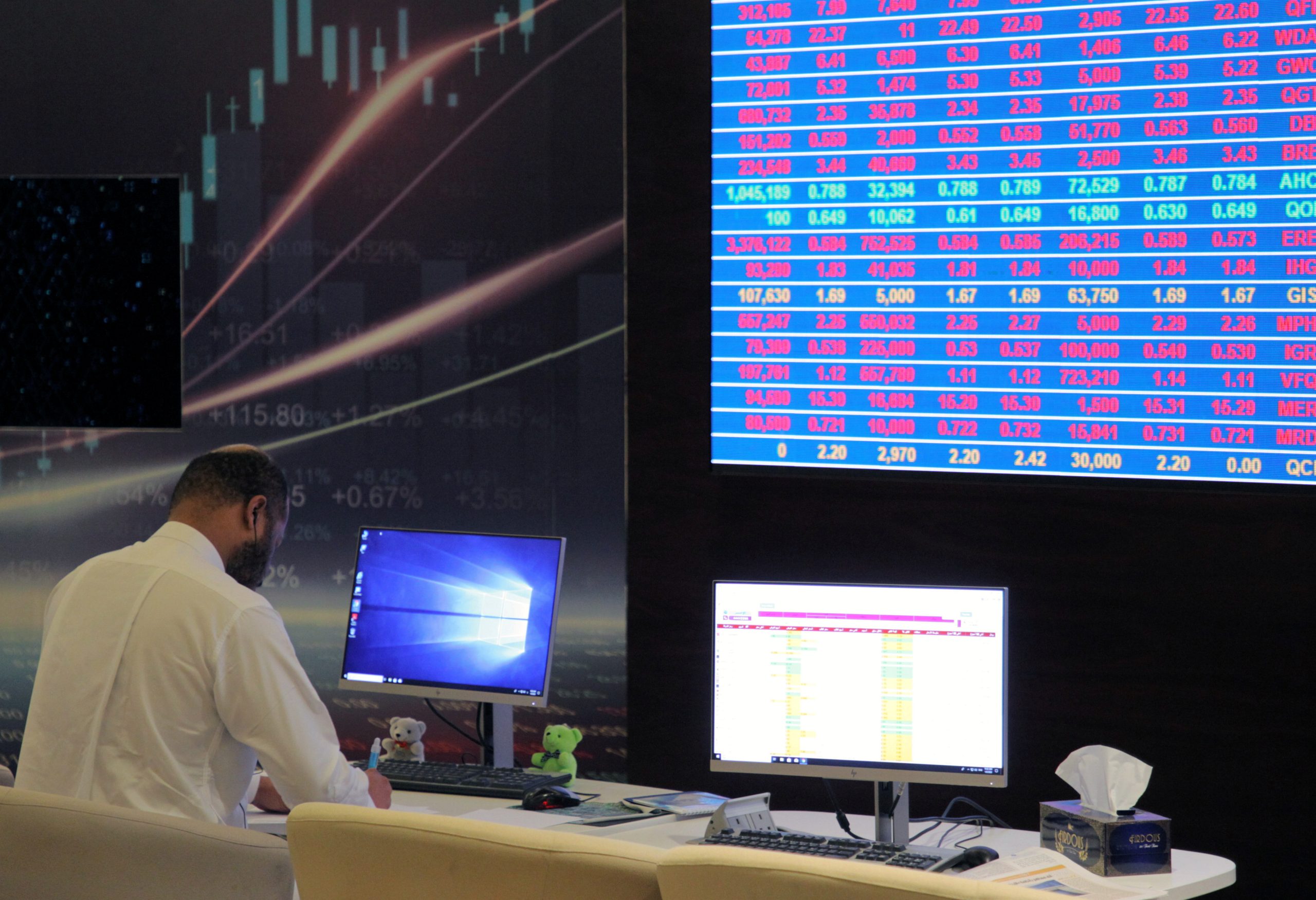
Abu Dhabi index closed higher on Friday, in line with oil prices after U.S. President Donald Trump issued a sweeping plan to boost U.S. production and demanded OPEC lower crude prices, while Dubai bucked the trend.Trump told business leaders at the World Economic Forum in Davos, Switzerland, on Thursday that he wanted to lower global oil prices, interest rates and taxes.Oil prices - a key catalyst for the Gulf's financial market - rose on Friday with Brent crude gaining 0.52% to $78.70 a barrel by 1145 GMTAbu Dhabi's benchmark index (.FTFADGI) settled 0.2% higher, extending gains to the fifth session with the largest lender, First Abu Dhabi Bank (FAB.AD), rising 1% and Adnoc Drilling (ADNOCDRILL.AD) increasing 0.5%.Among the gainers, National Bank of Ras Al Khaimah (RAKBANK.AD) surged 7.1% after the lender reported a 16.4% growth in full-year net profit after tax to 2.1 billion dirhams ($571.79 million).Abu Dhabi's outlook remains optimistic, with upcoming fourth-quarter results potentially providing additional support if they prove favourable, said Joseph Dahrieh, Managing Principal at Tickmill.However, Dubai's main index (.DFMGI) fell 0.4%, snapping a three-session gaining streak, dragged down by losses in heavyweight real estate and utilities sector stocks.Dubai's biggest developer Emaar Properties (EMAR.DU) declined 1.5%…
US investment bias might ebb if European gloom lifts

The extreme global investor bias for all things American may not need to end with some major U.S. shock, but could eventually reverse with just a modest lifting of the pervasive gloom surrounding Europe.Many experts are wary of the scale with which the U.S. is hoovering up global investment and the resulting strength of the dollar. This is raising fears that any missteps stateside could cause a sudden reversal of these gigantic cross-border flows.But the majority of those flows are coming from other rich economies, mostly in Europe. So the lack of a compelling case to stay at home is arguably as big a driver of the yawning geographic investment imbalances as the magnetic pull of Wall Street.Few question the attractions of the U.S. - impressively brisk growth, giant tech investment drivers, rising productivity and now, with the return of Donald Trump to the White House, a new round of deregulation to boot.Spurring this momentum is both the greater liquidity of U.S. markets compared to their foreign peers and the ever rising U.S. share of supposedly 'diversified' global equity and bond indexes. Indeed, U.S. stocks now make up two thirds of MSCI's all-country equity basket. (.MIWD00000PUS).But the sheer scale of…

Global equity funds gain inflows on Fed rate cut hopes, Trump’s AI plans

Global equity funds gained a fourth weekly inflow in five weeks in the week through Jan. 22 spurred by optimism for U.S. Federal Reserve rate cuts following cooling inflation and President Donald Trump's plans for extensive AI infrastructure spending.According to LSEG Lipper data, global equity funds attracted a net $7.42 billion worth of inflows during the weeks after having lost about $4.3 billion in outflows in the prior week.The MSCI World index (.MIWD00000PUS) has rallied nearly 5%, since the announcement of inflation report on Jan. 15, while the Europe's continent-wide STOXX 600 index (.STOXX) hit a record high of 530.55 on Wednesday.By region, investors snapped up a massive $6.69 billion worth of European equity funds. They also acquired Asian funds to the tune of $2.84 billion but ditched U.S. funds worth $3.2 billion on a net basis.Sectoral funds were popular as these funds garnered a net $4.86 billion worth of inflows, the largest since Nov. 13, 2024. Tech, financials and industrials attracted a notable $1.86 billion, $1.38 billion and $1.33 billion, respectively in inflows.Global bond funds drew a net $14.27 billion for a fourth consecutive week of net purchases.The high yields segment was particularly in demand as it attracted $2.72…

Australia’s corporate watchdog assessing regulatory response options after ASX CHESS outage

Australia's corporate regulator said on Friday it was assessing all options for a regulatory response, after bourse operator ASX's (ASX.AX) clearing and settlement software CHESS broke down last month.The Australian Securities and Investments Commission (ASIC) said it was deeply disappointed by the incident and the impact it had on the market."ASIC is engaging with the RBA (Reserve Bank of Australia) and stakeholders on the impact of the incident and lessons for the future," ASIC said in an emailed statement to Reuters.ASX said on Thursday it will pay a rebate of A$1 million ($628,000.00) to traders affected by deferred settlements due to the CHESS (Clearing House Electronic Subregister System) outage on Dec. 20."ASIC is in regular contact with ASX and has underlined its expectations for the ongoing resilience, reliability, integrity, and security of CHESS," ASIC said.ASX had been looking to replace the CHESS software using blockchain-based technology, but abandoned the overhaul in November 2022, six years after announcing it, citing concerns about the product's complexity and scalability.It is currently facing a lawsuit from Australia's corporate regulator alleging it misled the public about the progress of a troubled software upgrade.($1 = 1.5924 Australian dollars)Source: Reuters.com

Emerging economies facing “sudden stop” of capital flows, JPMorgan warns

Emerging markets could be seeing a dreaded "sudden stop" of capital flows as President Donald Trump's 'America First' policies pump up the U.S. economy and suck money away from poorer countries, investment bank JPMorgan warned on Thursday.Analysts fear sudden stops in capital flows because they starve economies of the money they need to grow or even just keep going.JPMorgan's in-house indications show there were $19 billion worth of "net capital outflows" from developing economies not including China in the last quarter, with another $10 billion expected to flee in Q1."Put simply, using the widely accepted academic definition, this would signal that EM ex China is on the verge of a sudden stop," the bank said in research note, adding that the phenomenon was not something "to be taken lightly".There are some caveats for now.The current slowdown in capital flows is not being driven by an EM-centric event, but rather the tightening of financial conditions globally as Trump's tariffs and tax cut pledges raise the possibility that U.S. interest rates stay higher for longer.With this in mind, "this is not a situation where specific EM countries are under pressure and are facing balance of payments or currency pressures as was the…

Trump accuses Bank of America, JPM of not doing business with conservatives

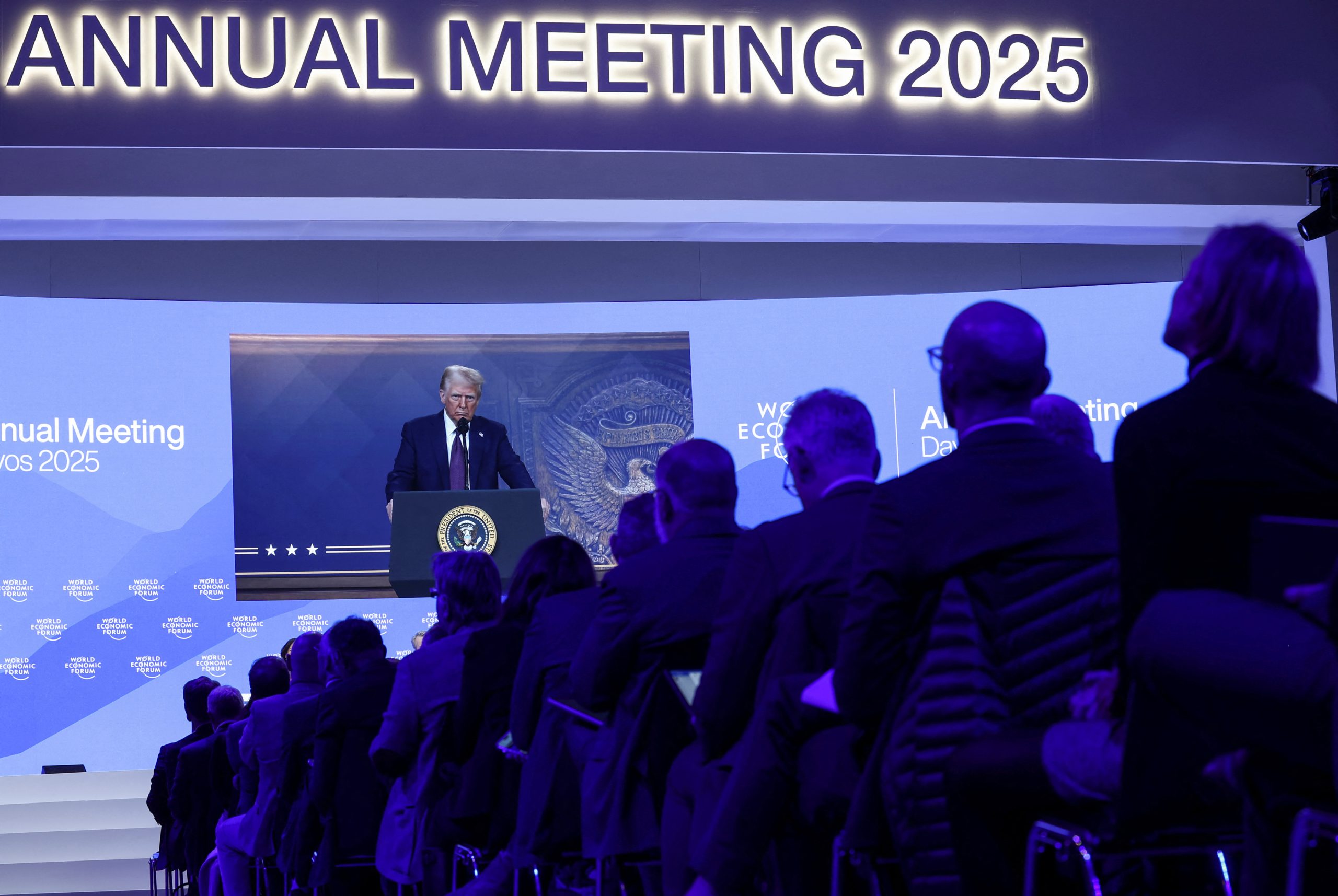
U.S. President Donald Trump on Thursday accused the CEOs of Bank of America (BAC.N) and JPMorgan Chase (JPM.N) of not providing banking services to conservatives.Trump, who returned to the White House on Monday, made a habit of accusing companies like Boeing and Ford of wrongdoing during his first term while praising others that furthered his political aims. In a campaign speech last year, Trump cited right-wing complaints about the U.S. banking system.Republican-led states have unleashed a policy push to punish Wall Street for taking stances on gun control, climate change, diversity and other social issues that have polarized the country."I hope you start opening your bank to conservatives, because many conservatives complain that the banks are not allowing them to do business within the bank, and that included a place called Bank of America," Trump said during an address at the World Economic Forum in Davos, Switzerland, via a video link."What you're doing is wrong," he said, without citing evidence or specifics of any wrongdoing, in a question-and-answer session with corporate leaders and CEOs assembled on stage.Bank of America CEO Brian Moynihan did not address the claim in comments right after Trump spoke, but complimented him on the U.S. hosting…

Energy, consumer staples push TSX to near six-week peak

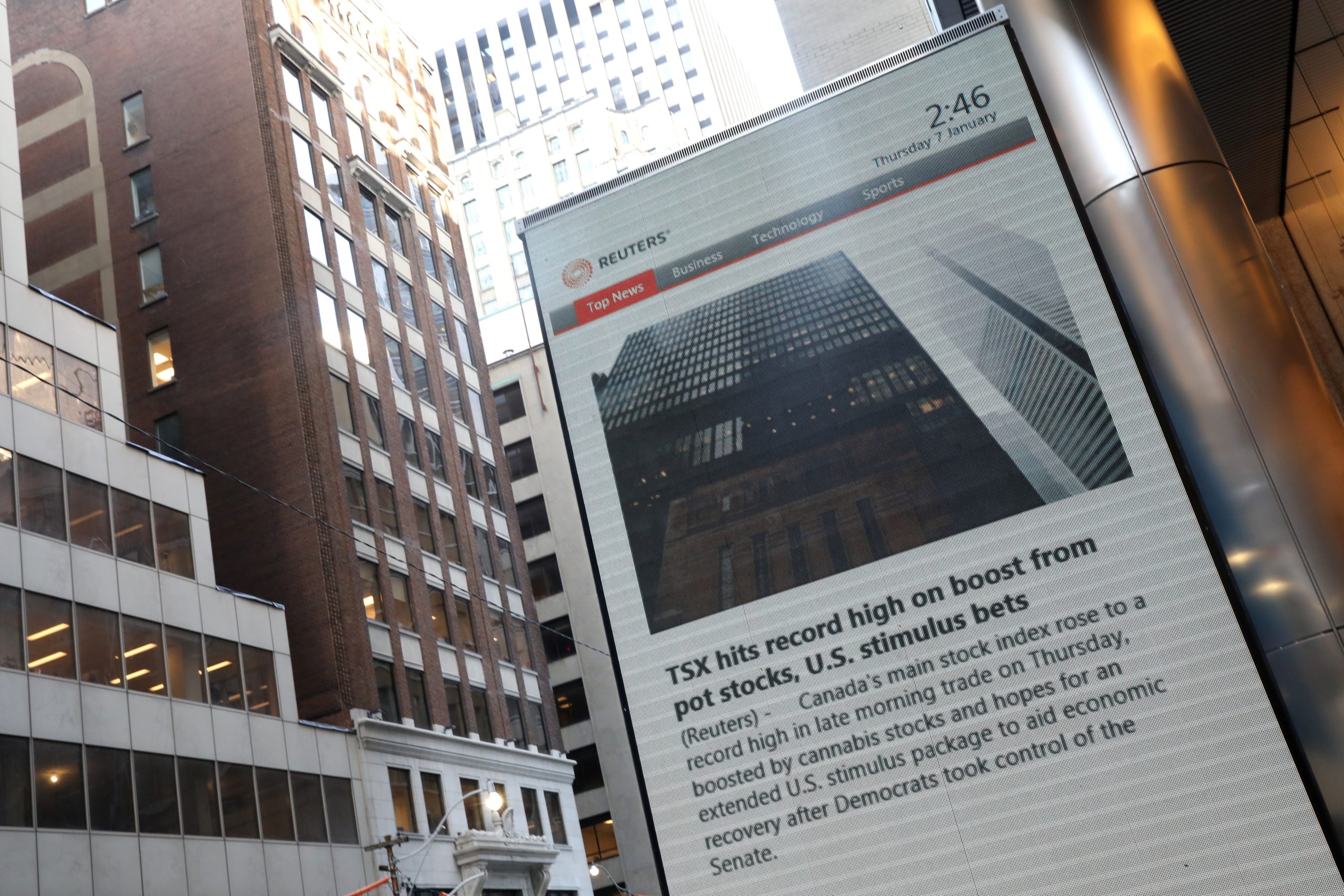
Canada's main stock index extended gains on Thursday, aided by energy and consumer staples shares, while investors remained curious about U.S. President Donald Trump's policy moves.The Toronto Stock Exchange's S&P/TSX composite index (.GSPTSE) was up 0.24% at 25,371.53, its highest since Dec. 13, and could log its eighth straight winning session if gains hold.On TSX, heavyweight energy (.SPTTEN) was the top winning sector, advancing 1.2%, taking cues from firm oil prices.A 0.8% gain in consumer staples (.GSPTTCS) also supported the index.However, metal mining shares (.GSPTTMT) limited overall gains, falling 1%, as gold prices dipped after hitting a near three-month high in the previous session.Markets will be watching for Trump's virtual address at the World Economic Forum in Davos at 11:00 a.m. ET, for further clarity on his policies."I think what Trump is telling the world is that the U.S. is open for business and in the first few days of his presidency, he has done away with a lot of restrictive policy and rules in the U.S.," said Allan Small, senior investment advisor at Allan Small Financial Group with iA Private Wealth.While Trump's stance of tax cuts and reduced regulation could benefit corporate profits, his tariff threats to Ottawa have…

Rate sensitivity haunts already elevated Brazil public debt

Investors already concerned about Brazil's ballooning public debt load under veteran leftist President Luiz Inacio Lula da Silva are being forced to reckon with an additional risk: a government debt profile with growing sensitivity to high interest rates.That's because Latin America's largest economy finances an unusually high portion of its debt through floating-rate bonds crafted to appeal to investors during times of market stress, a tool its Treasury was forced to lean on heavily last year, leaving the debt with its worst composition in 20 years.The rate sensitivity of Brazil's debt is poised to accelerate as the country's central bank aggressively tightens money supply to combat inflation, overshadowing improvements in the primary budget balance.No major country carries as much debt in floating-rate bonds as Brazil. Issuance of these instruments, known as LFTs, was the highest ever last year and their share of the total debt also rose by a record margin. Interest rate shocks now threaten to drive up the cost of servicing nearly half of the country's already large debt."In the past year, interest rates rose. And with LFTs, you pay that cost right off the bat," said former Treasury Secretary Paulo Valle, adding this implies a riskier and,…

Gulf markets end mixed amid Trump’s tariff plans

Stock markets in the Gulf ended mixed on Thursday, as investors remained cautious, keeping a watchful eye on U.S. President Donald Trump's policy announcements and their potential impact on the market.Trump said on Tuesday his administration was considering imposing a 10% tariff on Chinese goods starting Feb. 1. He previously said Mexico and Canada could face tariffs of around 25% from the same date.Such a move could significantly affect global trade and economic stability, with potential consequences, including higher prices for consumers and reduced economic growth.Trump's early presidency has been characterized by a flurry of executive orders over a wide range of issues causing investors to prepare for potential shifts in trade policies, tariffs, and economic measures leading to volatile market sentiment.Saudi Arabia's benchmark index (.TASI) eased 0.1%, hit by a 1.2% fall in Al Rajhi Bank (1120.SE).Elsewhere, Prince Alwaleed Bin Talal's investment company Kingdom Holding (4280.SE) declined 2.4%, a day after advancing more than 3%, after its CEO told Al Arabiya TV that the firm would be interested in investing in ByteDance's TikTok if Elon Musk or others stepped in to buy it.Separately, the kingdom's Crown Prince Mohammed bin Salman told Trump that Saudi Arabia wants to put $600…

FTSE 100 stalls after record run; CMC Markets tumbles

The UK's FTSE 100 stalled on Thursday after touching a record high in the prior session as investors sought clarity on U.S. President Donald Trump's trade policies, while shares in CMC Markets tumbled on a disappointing forecast.The blue-chip index (.FTSE) dipped 0.1% as of 1135 GMT, having touched an all-time high on Wednesday. The FTSE 250 midcap index (.FTMC) dropped 0.2%.Stock investors largely took comfort this week as Trump held off imposing hefty tariffs on his first day in the office and announced big investments in artificial intelligence infrastructure, sparking a rally in global tech shares.Focus is now on economic data, corporate earnings and remarks from Trump later in the day.In earnings-driven moves, CMC Markets (CMCX.L) dropped 14.2% after the trading platform's muted forecast fell short of investors' heightened expectations following upbeat projections from industry peers.IG Group (IGG.L) slipped 4.5% despite the online trading platform posting a 30% rise in its first-half profit.Auto distributor Inchcape (INCH.L) dropped 10.6%, with traders pointing a downgrade by J.P. Morgan.The FTSE 100-listed Associated British Foods (ABF.L) dropped 2.6% after it reported weak trading in its main UK market in the Christmas quarter and cut annual sales forecast for its Primark budget fashion retailer.Investors meanwhile…